 TickHint
Blog · Theses · Agents · Terminal · TickMate · Product
From a post to a thesis: read the call, then test it against the print
TickHint Dev Team · · 6 min read
Paste a public analyst’s post into the Terminal and TickMate explains the call against the bars it can see. One more sentence turns it into a thesis with written rules and an agent that checks every 15 minutes until the print, then sends one message to Telegram: validated, or failed. A flag, not a recommendation. This time the print came in hot and the test failed.
You read a lot of calls. A well-known analyst posts a clip: one chart explains the next inflation print, and here is the trade. It sounds right. You are not sure what would make it right or wrong, or when you would know.
The video above is one conversation in the TickHint Terminal on the morning of a US CPI print, in four chapters. The call is Kathy Lien’s, published the evening before: crude’s path in the CPI reference month calls the headline print, September crude fell, so September CPI should undershoot and the dollar should weaken, expressed in USD/JPY. She published no entry, stop or size. That matters later.
1. Read it for me
“Please read this post and the video, and explain Kathy’s thesis to me.” And the link.
TickMate finds the post, then finds the same clip on her YouTube channel and pulls the transcript, so it argues with what she actually said and not just the caption. Before a line of analysis it opens two charts on the canvas, oil and USD/JPY, to check her levels against the bars.
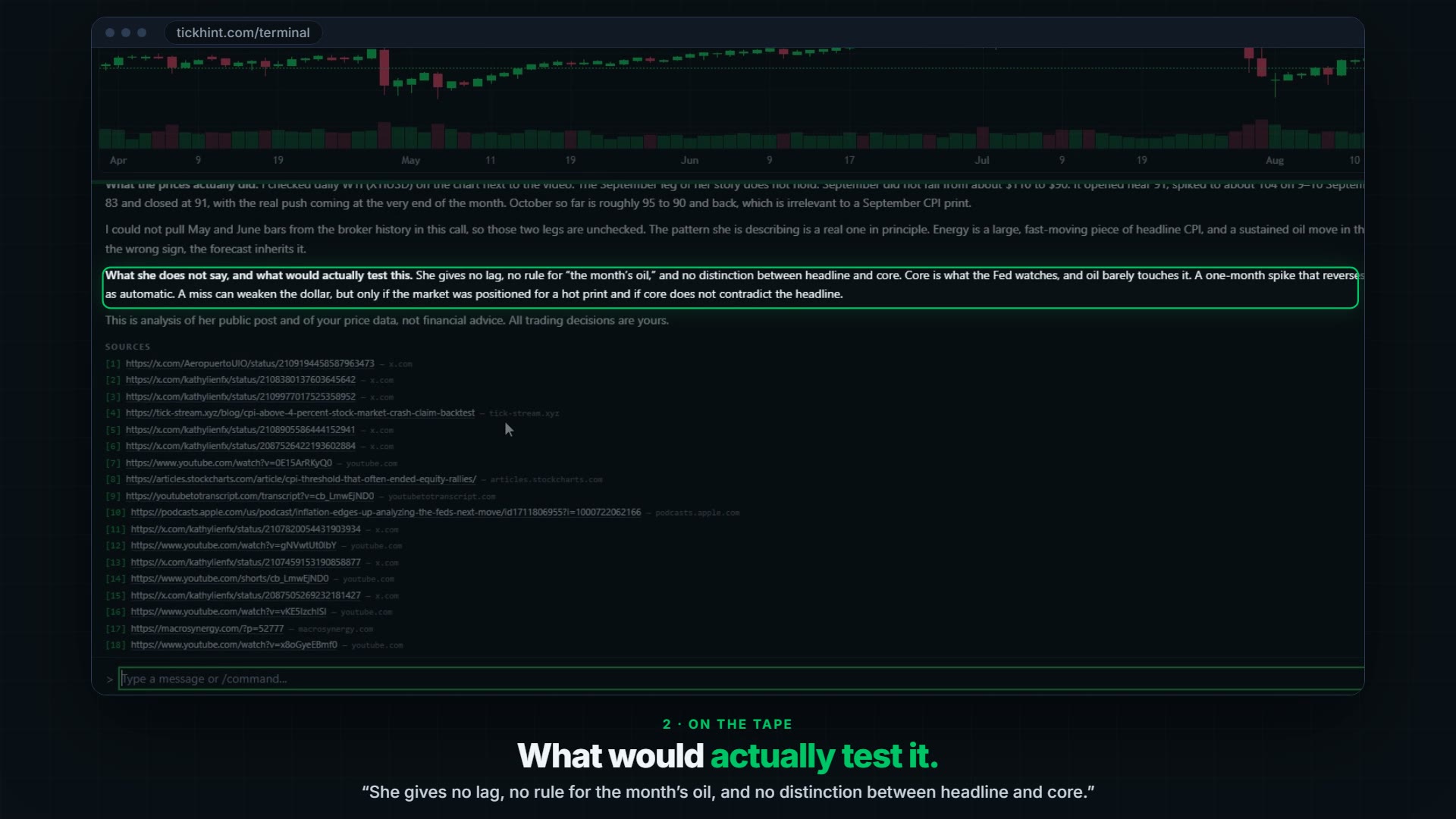
2. On the tape
The answer is not a summary. It is her numbers against the bars:
- The September leg of her story does not hold. September crude did not fall from about $110 to $90. It opened near 91, spiked to about 104 mid-month, and closed at 95. The real push came at the very end of the month. October so far is irrelevant to a September CPI print.
- What she does not say, and what would actually test this. She gives no lag, no rule for “the month’s oil”, and no distinction between headline and core. Core is what the Fed watches, and oil barely touches it. A miss can weaken the dollar, but only if the market was positioned for a hot print and core does not contradict the headline.
- Where it could not look. It says so: it could not pull May and June bars in that call, so those two legs are unchecked.
Then the line that is on every answer in the Terminal: “This is analysis of her public post and of your price data, not financial advice. All trading decisions are yours.”
3. Make it a thesis
“CPI print is today in the afternoon. Create a Thesis to track her ideas and spawn an agent to monitor it every 15 minutes until the CPI report today. If any trade ideas are validated send them to the Telegram.”
What happens next is the part we are proudest of, and none of it was scripted.
First it pins the facts: the release time, the live oil and USD/JPY quotes. Then: “Consensus is missing from the calendar, so I’ll look that up before I write the rules. Otherwise ‘undershoot’ has no number.” It searches, and reports that street consensus is the opposite of her call: a hot print, on gasoline. It writes that into the thesis as the test.
Then it schedules the monitor, reads back what it created, and catches its own mistake: “Its hours are 11:00–14:00 UTC, so the 10:14 slot is idle. I’ll open the window so the first checks actually run before the print.” It deletes the schedule and recreates it with the right hours.
4. Your call
The thesis is saved at conviction Low. It stores her claim as she stated it, and the two facts that already cut against it. The test is written down: her idea is validated only if the 12:30 UTC print comes in below 3.6% year over year or below 0.6% month over month, and core month over month is at or below 0.2%. A hot or in-line headline, or a headline miss with a hot core, invalidates it. “No size, entry, or stop was set, so none was invented.”
The agent runs every 15 minutes until the print. It stays quiet until the actuals are out. If her idea validates, Telegram gets the print, the consensus, the live USD/JPY price and the side, as a note, not an order. If the test fails, you get one message that it failed, with the numbers, and the thesis is marked invalidated. Either way it stops, and it retires itself the next morning if the print never arrives.
“The Telegram message will be the same: a flag, not a recommendation.”
The thesis gets a page: the claim, what cuts against it, the rules, and what it is watching. The monitor gets a row on your Schedules page, active, every 15 minutes. Pause it, edit it or delete it any time.
What the print said
It came in hot. Headline 3.7% year over year and 0.6% month over month against a 3.6% consensus. Core 0.3% month over month against 0.2%. Eighteen minutes after the release, on its next 15-minute check, the agent sent this to Telegram:
September 2026 CPI (released 12:30 UTC): headline 3.7% y/y / 0.6% m/m (consensus was 3.6%/0.6%); core 0.3% m/m / 2.6% y/y (consensus was 0.2%/~2.5%). USD/JPY is 158.791 right now. This missed Kathy Lien’s call — her idea was sell USD/JPY on a CPI undershoot, but the print came in hot on both headline and core, so her test FAILED. Thesis is now Invalidated. No trade, no size, not an order.
That is the whole feature in one message. The call was public and well argued. The test was written down before the number. The number came in, the test failed, the thesis is marked invalidated, and nobody was asked to approve anything. Had it validated, the message would have carried the side as a note, and ended on the same three words.
One print does not make her wrong in general, and it does not make the agent right. It makes the claim testable, which is what a thesis is for.
What it does, and what it does not
A thesis in TickHint is a research object: a claim, what would prove it wrong, the rules you would act on, and the evidence that accumulates. It can come from a post, a brief, a calendar event or your own head. An agent attached to it reads the tape on a schedule, judges what it sees against the rules, and writes a finding.
It never places a trade on its own. In this video it is not even asked to propose one. When an agent does propose a trade, it is a card with two buttons, Approve and Dismiss, and nothing reaches your broker without the first one. The analysis is based on a public post and public data; it is not investment advice, it can be wrong, and the person who made the call owes you nothing.
Plans
Theses and scheduled agents are part of Pro. Founding members, the first 200 Pro accounts, get $10 off every month for 12 months with the code FOUNDING at checkout. See the plans.
The next call you half believe is one paste away. Start free, and ask what would actually test it.